


“Leo didn’t make the football team; not enough talent.” That’s often how it sounds when a desired goal remains out of reach. In the classroom, too, an alleged lack of talent is used as an excuse: Foreign languages? “Melissa just doesn’t have a talent for it.” Mathematics? “It doesn’t run in our family.” Talent becomes a catch-all argument, an explanation for why a child “just can’t do it.” Often, the supposed lack of talent also serves as a justification for not even trying.
The message behind this is fatal: either you have it “in your blood” or you might as well give up. But is that really true? Is a lack of talent the main reason for failure? The reality of education paints a more nuanced picture. Many supposedly talented individuals fall short of their potential, while others with average ability achieve outstanding results. The difference often lies in factors related to effort and mindset, not innate talent.
Intelligence as a Secondary Factor
Studies show that diligence and perseverance outperform pure talent in the long run. In 2007, educational psychologist Angela Duckworth demonstrated with her “Grit” study that perseverance and passion are better predictors of long-term success than IQ. In two longitudinal studies, researchers followed more than 2,000 pupils and students over several years, including at military academies, elite high schools, and universities in the United States. The results showed that not intelligence, but the persistent pursuit of a goal, best predicted later success. Schools, therefore, should not place talent at the center.
Demystifying Talent
Nick Alchin, author, educator, and head of the United World College in Singapore, one of the largest schools in Asia, warns against a fixed view of talent. In his text “Zero talent required: qualities for growth,” he writes that schools focused on talent create environments in which students collapse at the first sign of difficulty. Alchin explicitly calls for demystifying the myth of talent. Instead, the focus should be on qualities that require no talent at all. Only such qualities form a real foundation for competence. Alchin is convinced that schools should prioritize strengthening traits such as perseverance, resilience, and a willingness to learn rather than promoting talent. These are what enable long-term success.
“It’s less about the learning content and more about the learning mindset.”
Simone Ruckli also aims to cultivate these qualities. She founded the private school Arborana for gifted children in the canton of Zurich. “Without resilience, perseverance, and the knowledge of how to learn, even very talented and intelligent individuals can stumble,” she is convinced. Talent alone does not lead to academic success, emphasizes the educator. It requires a combination of various skills and competencies – most of which are learned and developed.
Mindset as the Key
But if talent is overestimated, what truly leads to lasting learning success? American psychologist Carol Dweck shows in her research that a growth-oriented mindset contributes more to long-term learning success than innate intelligence. According to this, school success is also the result of the right attitude. For teachers, this means: instead of placing learners into categories such as gifted or not gifted, educators should deliberately foster attitudes and skills that enable sustainable learning. “It’s less about the learning content and more about the learning mindset,” Simone Ruckli explains. “Teachers are needed primarily as coaches who challenge, support, guide, and encourage reflection.”
Effort Pays Off
With or without talent: effort is always part of the learning process. But can teachers today still insist on effort and perseverance – or even demand them? Hard work often has a negative image and is frequently perceived as outdated, unfair, or even painful. How, then, can the shift from a talent mindset to a work mindset succeed?
We try to make effort visible and highlight learning progress. This means that what learners achieve is based on the effort they put in and their personal development, not on attributed talent,” Simone Ruckli describes the mindset at her school. “What matters is not what talent and knowledge learners bring with them, but how they manage to develop, apply, and learn from both.” When teachers strengthen patience and resilience, they can foster sustainable learning in their students.
Those Who Persist Move Forward
Putting in effort, committing, persevering, continuing to learn. Take Angela, for example: diligent in school, but not brilliant; a consistent learner, constantly asking questions, never giving up. Or Albert: a boy who struggled with authoritarian teaching styles, skipped classes, worked through content independently, learned only what interested him, and provoked his teachers.“
What became of them? Angela Duckworth is now an educational psychologist, internationally known for her research. Albert Einstein revolutionized the field of physics with his theories. Both demonstrate impressively: success is not solely the result of innate talent. It is the result of thinking strategies, learning attitudes, and perseverance.
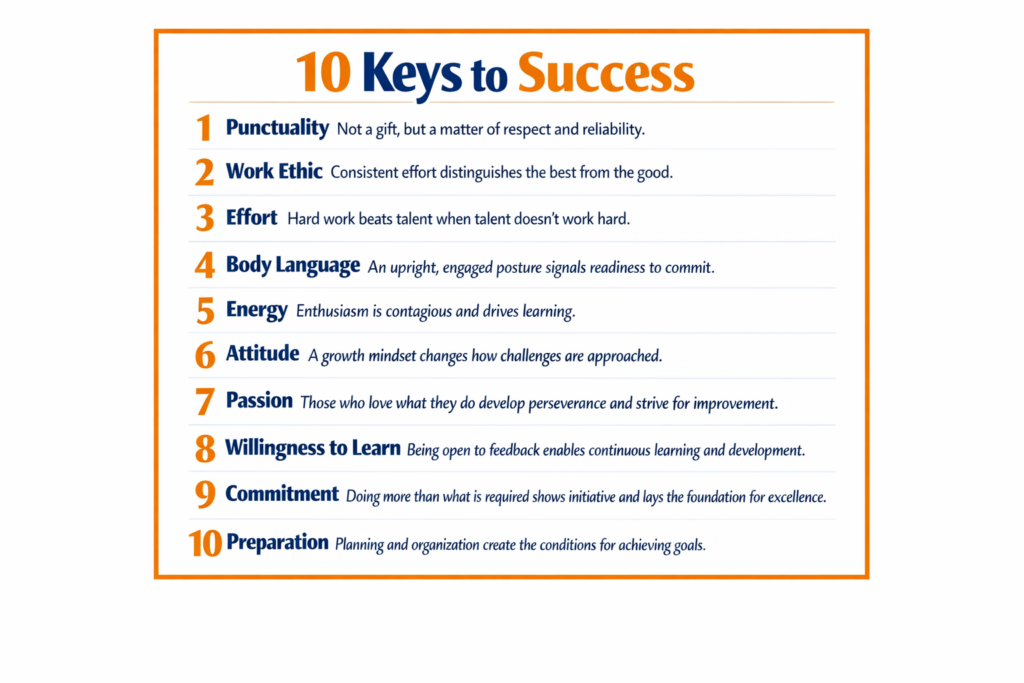
Ten Qualities That Require No Talent
None of the following qualities fall from the sky. But every student can acquire them. Talent plays no role in this context. Success in school and career is therefore not an exclusive club for a few exceptional talents, but the result of the right habits and attitudes; something schools can teach.
A Different Story About Learning
If talent isn’t the deciding factor, then the story we tell about learning needs to change.
What if schools focused less on identifying who is “gifted”, and more on helping every student build the skills that actually drive success? What if effort, curiosity, and the ability to learn became the true benchmarks of progress?
This shift isn’t just theoretical. It’s exactly what we’re working on with enduri: supporting schools in putting learning skills – like thinking, reflecting, and learning how to learn – at the center of the classroom experience. Because in the end, success is not about who starts ahead. It’s about who keeps going.