


John Hattie, the world’s most influential educational researcher, visited Switzerland. His visit was both an inspiration and a wake-up call.
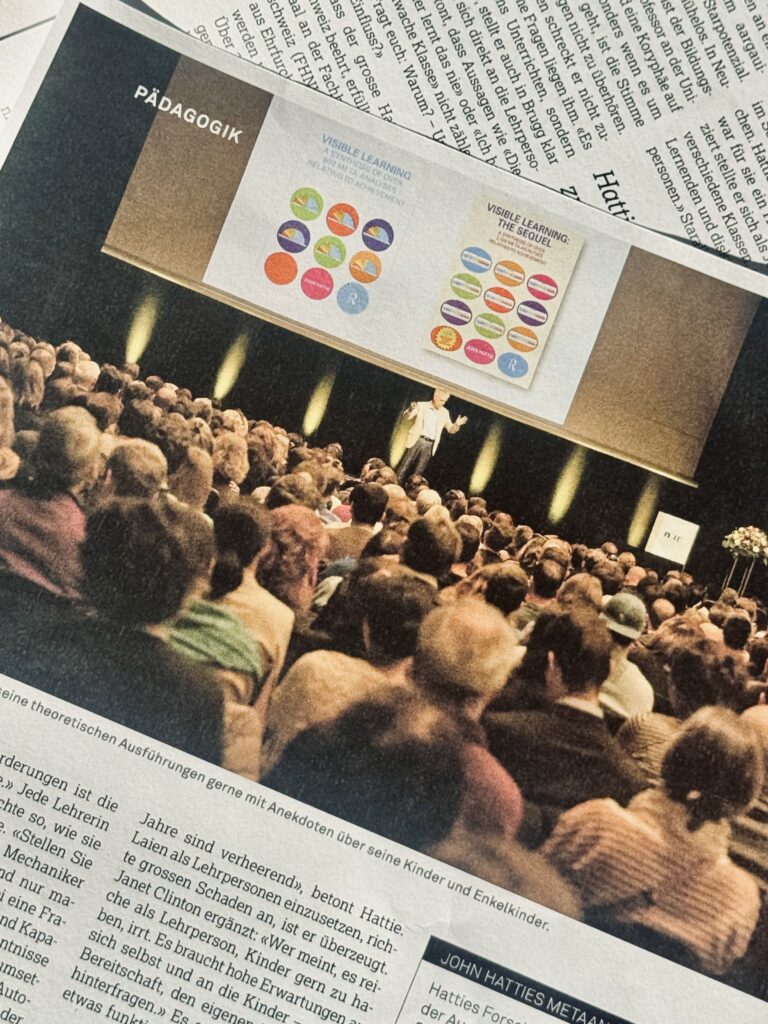
Anyone who manages to attract 750 people to a lecture in the small Swiss town of Brugg on a sunny Wednesday afternoon in March clearly has star potential. John Hattie does so effortlessly. The New Zealand-raised educational researcher and emeritus professor at the University of Melbourne is a luminary: the “Rolling Stone of education.”
Even at 76, he remains the most prominent global voice on effective learning: impossible to ignore, concise, and direct. He does not shy away from disharmony. Uncomfortable questions suit him well. “It’s not about teaching, it’s about learning,” he makes clear in Brugg, addressing teachers directly: “Statements like ‘This student will never learn this’ or ‘I have a weak class’ don’t count. Ask yourselves: Why? – and what your own impact is.”
The fact that Hattie has honored small Switzerland with his presence fills the packed auditorium at the University of Applied Sciences and Arts Northwestern Switzerland (FHNW) with a mixture of reverence and excitement. Autographs are requested, selfies taken. More than 2,000 education enthusiasts follow his talk via livestream. A visibly moved Pierre Tulowitzki, professor of educational management and school development at FHNW, captures the mood in his opening remarks: “What a dream!”
“Focus on thinking and learning. Don’t ask what, but why.”
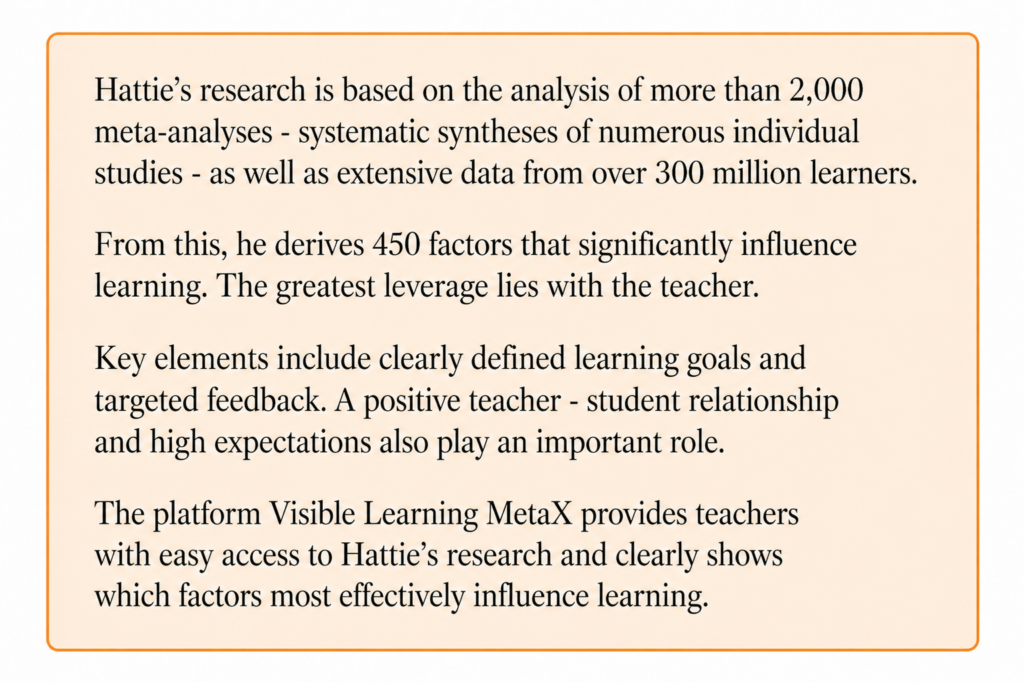
Anyone expecting a mellow academic softened by age on stage is mistaken. With energy, Hattie makes one thing unmistakably clear: “Representative data are not the problem in learning research; interpretation is.” And that is precisely what he has been committed to for decades. His theories are based on a universe of studies, school visits, statistics, and analyses. His book Visible Learning is considered a foundational work in learning and teaching research. First published in 2008, its core message remains as relevant as ever: How do students learn most effectively, and how can teachers deliberately influence this process? Or, as Hattie puts it pointedly: “Focus on thinking and learning. Don’t ask what, but why.”
Teacher, Researcher, Explorer
Hattie forms his own impression of how children learn in Switzerland by visiting selected schools. One of them is the Mellingen-Wohlenschwil school. Here, Monique Struck, classroom teacher and pedagogical school leader, has been working with Hattie’s approach for over ten years. She and her team are part of a network of schools that consciously implement teaching and learning principles in everyday practice.
Meeting Hattie in person was a highlight for her. “He introduced himself simply as John, visited different classes, sat with the students, and discussed with the teachers.” Star airs are foreign to Hattie. Language barriers, age, or background play no role. He seeks direct, equal exchange. His mission: to make school the best possible place for learning. A teacher at heart, a researcher in mind, an explorer in attitude.
“Many academics lack dialogue with the outside world. They research and publish for other academics. With John, it’s different,” says Janet Clinton, professor of education and evaluation at the University of Melbourne. She likely knows Hattie best. They have been married for 41 years, with three sons and seven grandchildren. John, she says, is grounded and curious.
On stage, Hattie complements his analyses with anecdotes from his private life; his granddaughter who didn’t want to return to school after her first day, or his son who chose water polo as his high school specialization instead of chemistry or physics. For a moment, the world-renowned researcher, who began his career as a teacher, becomes “one of them” to the audience. In Brugg, Hattie and Clinton briefly share the stage – a lively exchange between education experts. The difference between stage and home? “We argue less on stage,” Hattie says with a laugh.
“It’s hard to grasp what it means to hold even a rough understanding of 450 factors influencing school learning.”
That Hattie came to Switzerland at all is thanks to an alliance between the Intercantonal University of Special Needs Education, the Zurich University of Teacher Education, and the University of Teacher Education Northwestern Switzerland. At the latter, Wolfgang Beywl works as a lecturer in school and teaching evaluation. He has known Hattie for years, translated parts of his books into German, and coordinated the Swiss visit. “John impresses me with his generosity in sharing his knowledge, but also with his ability to keep ‘the big picture’ in mind. It’s hard to grasp what it means to hold even a rough understanding of 450 factors influencing school learning.”
Hope Is Not a Strategy
Yet despite Hattie’s prominence and the strong resonance of his work, his recommendations are ignored in many schools. Hattie explains: “One of the major challenges is teacher autonomy.” Each teacher teaches as they see fit. “Imagine if your doctor or mechanic worked the same way and only did what they liked.” Whether teachers implement research findings in their classrooms depends on motivation, willingness, and capacity, or the lack thereof. The biggest problem, he says, is a lack of courage. Or, in Hattie’s words: “Hope is not a strategy.” What is needed is trust, strong school leadership, leadership in general, and a collective effort.
Jörg Berger knows these attributes well. He is co-principal of the school in Knonau and a board member of the Swiss Association of School Leaders. For him, Hattie’s visit is a source of motivation. “Having high expectations for students, avoiding labels, thinking beyond subject boundaries, collaborating – and thus enabling the best possible learning. That is exactly how education should work.”
“Anyone who believes it is enough to like children to be a teacher is mistaken.”
But this requires capable educators, especially in times of teacher shortages and artificial intelligence. “Having an incompetent teacher for one year is tragic for a child. Two years are devastating,” Hattie emphasizes. Using unqualified individuals as teachers causes serious harm. Janet Clinton adds: “Anyone who believes it is enough to like children to be a teacher is mistaken. It requires high expectations of oneself and of the children, and a willingness to question one’s own teaching.” It is not about whether something works, but what works best.
Why do first graders still go to school with curiosity and enthusiasm, while for many teenagers it becomes a burdensome obligation? “I would wish that a twelve-year-old still had that same curiosity and passion for learning,” says Hattie. That is precisely why he uses his voice—clear and unmistakable—to set things in motion, even if it sometimes causes friction. That’s simply the nature of a Rolling Stone.
A slightly different version of this article was published in German in the Swiss journal “Bildung Schweiz” in May 2026.
