


Boredom hinders learning in school and is therefore the opposite of what teaching aims to achieve. Can it nevertheless be of benefit to learners?
Boredom is often equated with poor teaching, incompetent teachers, or disinterested students. No matter which perspective one takes, the phenomenon is seen as negative. Being a bore is never a compliment, and a boring lesson is hardly a mark of quality. But what exactly is boredom?
Psychologist John Eastwood, known for his research on boredom and author of Out of My Skull: The Psychology of Boredom, defines boredom as “the unpleasant feeling of wanting, but being unable, to engage in a satisfying activity.” In other words, boredom arises when there is a gap between the level of stimulation we need and the input we actually receive. At the same time, boredom is unpredictable—rarely linear and highly dynamic. It appears suddenly and can disappear just as quickly.
Boredom as an Important Signal
In the classroom, boredom manifests in different ways: some children slump in their chairs, others become restless, doodle, disrupt, or withdraw. The key question is: Are students underchallenged? “Not only underload but also overload can trigger boredom,” says Wanja Wolff, sports psychologist and researcher at the University of Hamburg. “What matters is the fit between demands, abilities, and the perceived meaning of a task.”
Mathematics lessons are a good example. Many students disengage, not because mathematics itself is boring, but because it feels too fast, too slow, too complex, too easy, or simply pointless. The fit is off. Boredom is the signal. Time seems to drag, attention drops to zero, and the desire to escape the situation dominates. The good news: boredom is not a permanent state but situational and therefore temporary. When it becomes chronic – that is, constant – it may be linked to depression or anxiety disorders.
“Imagine placing your hand on a hot stove. The pain makes you react immediately and pull your hand away. Boredom works in a similar way; it is an unpleasant sensation that motivates you to respond as quickly as possible.”
Wanja Wolff is an expert on boredom. The German professor of sports psychology at the Faculty of Psychology and Movement Science in Hamburg served as a scientific advisor for the exhibition “Boredom – Surprisingly Diverse” at the Vögele Kultur Zentrum in Pfäffikon, Switzerland. Wolff compares boredom to pain. “Imagine placing your hand on a hot stove. The pain makes you react immediately and pull your hand away. Boredom works in a similar way; it is an unpleasant sensation that motivates you to respond as quickly as possible.”
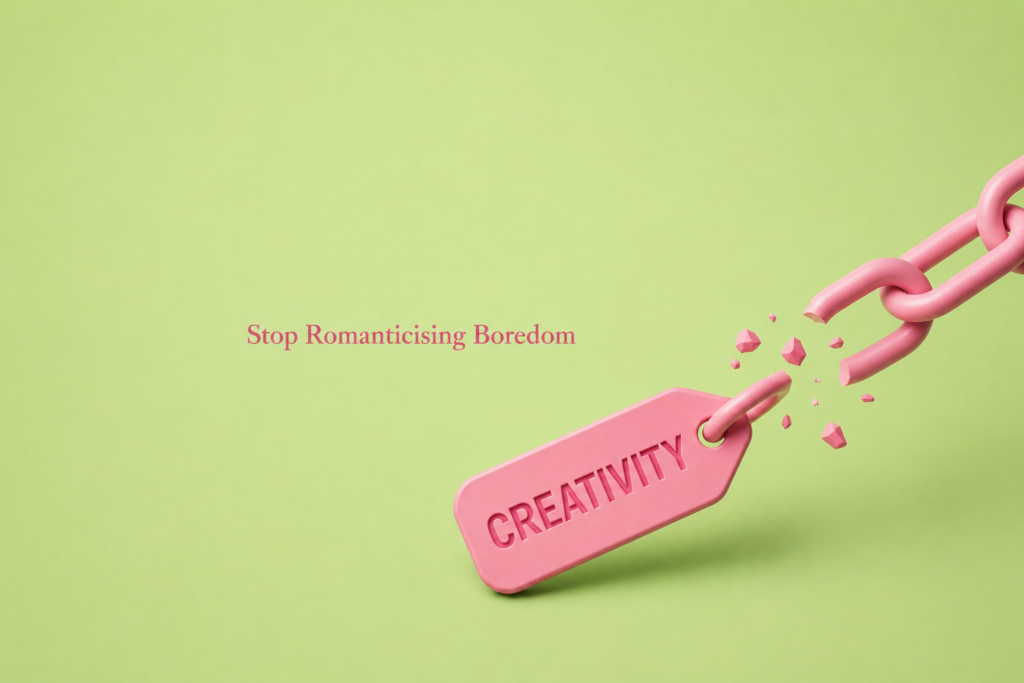
Boredom = Creativity?
The idea that boredom fosters creativity is more myth than fact. There is a lack of representative studies that clearly demonstrate a general boost in creativity caused by boredom. Thomas Götz, an educational psychologist at the University of Vienna, is one of the strongest critics of “positive boredom.” In an interview with the German news magazine Spiegelin March 2025, he states unequivocally: “Boredom is unjustifiably praised. It is harmful and associated with unhealthy behavior. This ranges from eating out of boredom to risky activities such as the train surfing some teenagers engage in. In school, the rule is: children who are bored achieve worse grades.”
Those who are bored lack motivation, attention, and effort. At best, boredom may serve as a prompt to try something new. But there is no guarantee that constructive creativity will replace mental emptiness. Disruptive or even destructive behavior may just as easily take its place. At the same time, the question arises: how do we define creativity? Is an eight-year-old student who, out of boredom, cuts open the new feather pillows in school library and turns it into a fictional snowy landscape destructive, creative, or disruptive?
Boredom Has Nothing to Do with Leisure
It is important to distinguish between boredom and idleness. Boredom has nothing to do with “leisure.” Voluntary inactivity can be restorative and positive. Boredom, on the other hand, is experienced as negative and is an aversive state that people seek to escape. Even being busy does not protect against boredom: one can be stressed and occupied and still feel bored.
Boredom is a universal impulse that occurs across cultures and social classes. It does not disappear with age; however, the way people deal with it and their options for action change. Adults who feel bored at work can get a coffee, change their workflow, seek new stimuli, or quit their job. Students in a classroom do not have these freedoms. Their options are limited: switch off, doodle, or disrupt.
Adults who feel bored at work can get a coffee, change their workflow, seek new stimuli, or quit their job. Students in a classroom do not have these freedoms. Their options are limited: switch off, doodle, or disrupt.
The simplest solution might seem to be to “pull the plug” on boredom preemptively to avoid it altogether and escape it as quickly as possible when it arises. This is as impossible as it is ineffective. Expert Wanja Wolff uses a sports analogy: “There are training sessions that are boring, repetitive, and unpleasant. Yet they are necessary because they optimize certain energetic processes or help acquire specific skills.” It is important to explain to athletes the purpose and personal benefit of the session. Understanding fosters motivation and interest. The same applies to learning.
A study published in November 2025 in the British Journal of Educational Psychology by the Universities of Potsdam and Hamburg shows that interest and real-life relevance can effectively reduce boredom. What does this statistic mean for my own life? And what benefit does this task have for me? When purpose and relevance make sense in a personal context, boredom becomes more tolerable and can even be useful.
Humor, Enthusiasm, and Analysis
For schools, this means: boredom is neither a character flaw of teachers or students nor a declaration of boycott against a particular system. It is a signal. When students are bored, it is worth questioning and analyzing: Is the task too easy? Too difficult? Does it lack meaning or real-world relevance?
Wanja Wolff recommends a pragmatic approach: take boredom seriously, analyze its causes, and design lessons so that alignment, meaning, and interest coincide as often as possible. Ideally, boredom becomes a constructive prompt: “Do something different!”
According to educational psychologist Thomas Götz, there are two additional factors that counter boredom: humor and enthusiasm. Where there is enjoyment and engagement, boredom stands no chance.
published in the Swiss Journal “Bildung Schweiz“, May 2026
